Media Center
Discover our latest company announcements, engineering insights, and industrial success stories.
Gaming PC & RTX Power Backup in Bangladesh — Pure Sine IPS vs Online UPS
Direct answer
High-end gaming PCs with RTX-class GPUs and Active PFC power supplies (650W–850W+) need a pure sine wave IPS (e.g. Kenson LX-1524 or LX-2024 on 24V) or a true online double-conversion UPS for medical/server-grade stability. Modified sine wave offline UPS units often cause reboots, PSU shut-down, or coil whine during transfer because Active PFC front-ends reject stepped waveforms.
1. Typical gaming load in Dhaka apartments
A modern RTX gaming build often draws:
- GPU + CPU peak: 450W–700W under gaming load
- Total desk load (monitor, router, RGB): 550W–850W
- Startup inrush: Active PFC PSUs can spike briefly higher — size IPS/UPS with 25–40% headroom
2. Recommended Kenson pure sine IPS architecture
| Setup | Recommended IPS | Battery bank | Est. backup @ ~500W |
|---|---|---|---|
| Single RTX mid-range + 650W PSU | Kenson LX-1524 (1500VA / 24V) | 2× 12V 130Ah–150Ah SMF | ~2.5–3.0 hours (50% DoD estimate) |
| RTX 4070/4080 class + 750W–850W PSU | Kenson LX-2024 (2000VA / 24V) | 2× 12V 200Ah SMF | ~3.0–3.5 hours (50% DoD estimate) |
3. When to choose online UPS instead
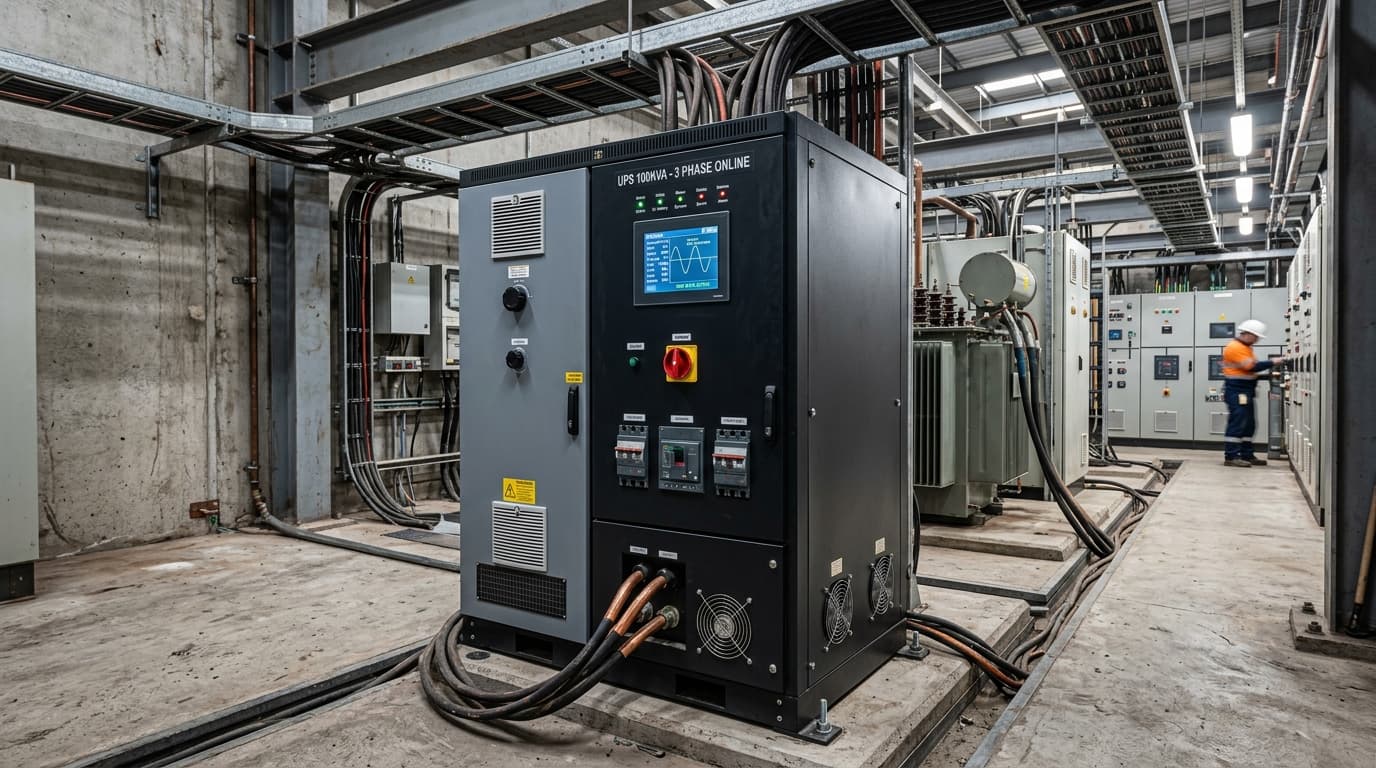
For dual-PC streaming rigs, workstation-class GPUs, or combined gaming + CCTV NVR loads above 1kW continuous, consider a true online UPS (e.g. Wismar KL series) with external battery bank sizing from TNS application engineering. Online topology delivers 0ms transfer and tighter voltage regulation for sensitive Active PFC supplies.
4. Why modified sine wave fails on gaming PSUs
Budget offline UPS units output a stepped approximation of AC. Active PFC controllers in modern ATX PSUs interpret the waveform as out-of-spec input, triggering protective shutdown or rapid cycling during the 4–10ms relay transfer — the PC appears to “hard reboot” every load-shedding event.
Calculate your backup time
Use the official TNS backup calculator (V × Ah × DoD × 0.85 ÷ W).
Industrial Online Double-Conversion UPS: Sizing & SVR Protection Guide
Executive Summary
Industrial manufacturing facilities, textile spinning mills, healthcare surgical suites, and cloud data centers in Bangladesh require continuous, zero-transfer (0ms) clean power. Raw utility lines suffer from voltage sags, phase imbalances, frequency drift, and high-voltage spikes that damage automated PLCs, CNC machinery, and medical imaging scanners. A true Online Double-Conversion UPS continuously rectifies raw AC utility power into filtered DC and inverts it back into a pure, precision-regulated sine wave (±1% voltage accuracy, 0ms transfer).
1. Why Standard Offline UPS Fails in Industrial Environments
In an offline or line-interactive UPS, connected equipment runs on raw utility power until a blackout occurs, triggering a relay transfer that takes 8 to 15 milliseconds. While desktop office computers may tolerate brief transfer lapses, modern industrial equipment cannot:
- Microcontroller Dropouts: Automated textile spinning frames, circular knitting looms, and automated pick-and-place robots crash and lose production state when input power dips for more than 4ms.
- Contactor Chattering: Magnetic motor starters and motor contactors disengage during voltage sags, tripping main plant feeder lines.
- Frequent Utility Sags: Industrial grids in Gazipur, Narayanganj, Savar, and Chittagong experience frequent brownouts down to 150V. Offline units switch constantly to battery, exhausting battery reserves and destroying cells prematurely.
2. Inside True Online Double-Conversion Topology
An Online UPS operates under a continuous four-stage power transformation process:
- Stage 1 (IGBT Rectifier & PFC): Converts incoming noisy AC utility power into stable DC while maintaining an input power factor > 0.99 and low input harmonic distortion (THDi < 3%).
- Stage 2 (DC Bus & Battery Buffer): The internal DC bus connects directly to the battery bank. Energy is continuously drawn from the DC bus—meaning there is zero mechanical relay transfer (0ms) when utility power fails.
- Stage 3 (Precision PWM Inverter): High-frequency IGBT switches reconstruct a pure, precision sine wave output with ±1% voltage stability and zero frequency variation.
- Stage 4 (Static Automatic Bypass): A solid-state thyristor static bypass switch enables instantaneous, seamless transfer to raw mains in the event of severe downstream load short-circuits or internal maintenance.
3. Capacity & Sizing Reference Matrix
| Capacity | Phase / Topology | Target Industrial Application | Recommended Series |
|---|---|---|---|
| 1kVA – 3kVA | 1-Phase In / 1-Phase Out | Pathology lab analyzers, ultrasound workstations, IT server racks | Bremen / Wismar Series |
| 6kVA – 10kVA | 1-Phase or 3-Phase In | Hospital OT suites, broadcast studios, bank branch data centers | Wismar W1106 / W1110 |
| 15kVA – 30kVA | 3-Phase In / 3-Phase Out | Automated packaging lines, CNC machinery, diagnostic imaging | Howa Power / G-Mac 3:3 |
| 40kVA – 120kVA | 3-Phase In / 3-Phase Out | Commercial IT server farms, textile central control centers | Hanover LX-33 Series |
| 160kVA – 600kVA | 3-Phase In / 3-Phase Out | Heavy spinning frames, continuous dyeing, centralized plant power | Hanover Industrial Low-Frequency |
4. Pre-Regulation with Servo Automatic Voltage Regulators (AVR)
In harsh industrial zones where utility voltages experience extreme swings (e.g., 280V to 450V line-to-line), pairing an industrial Servo Motor Automatic Voltage Regulator (such as Howa Power SBW Series) upstream of the Online UPS protects the rectifier electronics from catastrophic overvoltage stresses while preserving battery life.
5. Turn-key Industrial Supply & 24/7 Field Engineering
TNS Engineering Ltd provides end-to-end industrial project execution across Bangladesh:
- Electrical load audit, power factor measurement, and harmonic distortion analysis.
- Single Line Diagram (SLD) engineering consultation and substation integration.
- Khilgaon Central Testing Hub bench load testing before client dispatch.
- Annual Maintenance Contracts (AMC) with guaranteed 2-hour emergency dispatch in Dhaka industrial zones.
Require Turn-Key Project Consultation or Sizing?
Contact our senior application engineers for SLD review and project quotation.
VRLA AGM vs. Tubular vs. LiFePO4 Lithium Batteries: Complete Selection Guide
Executive Summary
Selecting the right battery technology for your IPS or UPS in Bangladesh determines reliability, maintenance overhead, safety, and 10-year operating cost. VRLA AGM batteries (such as Kenson) provide 100% sealed, maintenance-free operation with zero toxic acid fumes—making them ideal for living spaces. Flooded tubular batteries offer 1,000–1,200 cycles but require regular distilled water replenishment and dedicated ventilation. Lithium LiFePO4 represents modern energy storage, delivering 4,000–6,000 cycles, 90% usable capacity, and 3x faster charging.
1. The Three Battery Chemistries in Bangladesh
A. Valve Regulated Lead-Acid (VRLA AGM) — The Zero-Maintenance Standard
VRLA AGM batteries utilize micro-porous glass fiber separators (Absorbent Glass Mat) that absorb and immobilize liquid sulfuric acid electrolyte. During charging, oxygen generated at the positive plate migrates through the separator to recombine with hydrogen at the negative plate, regenerating water inside the cell.
- Zero Maintenance: Never requires distilled water refilling or acid specific gravity checks.
- No Toxic Fumes: 100% safe to install inside bedrooms, living areas, and office cubicles.
- Low Self-Discharge: Can sit in storage for up to 6 months without degrading.
B. Flooded Deep-Cycle Tubular Batteries
Tubular batteries encase positive active material in porous gauntlets, protecting lead plates from shedding during deep discharge cycles. While robust, flooded tubular batteries emit hydrogen gas and acidic vapors during daily charging:
- Requires bi-weekly or monthly inspection and distilled water top-ups.
- Must be installed in well-ventilated utility rooms or balconies to avoid respiratory irritation and explosion risk from accumulated hydrogen.
- Acid mist can corrode nearby terminal lugs, cables, and home tiles.
C. Lithium Iron Phosphate (LiFePO4) — The Modern High-Performance Choice
LiFePO4 is the safest, longest-lasting lithium chemistry available for stationary energy storage. Paired with a Smart Battery Management System (BMS), it monitors cell balance, over-temperature, and short-circuits in real-time.
- Exceptional Lifespan: 4,000 to 6,000 cycles (lasts 10 to 15 years in daily load shedding).
- High Usable Depth of Discharge: Safely discharges up to 90% capacity without degrading cells.
- Ultra-Fast Recharging: Recharges fully in 2 to 3 hours, compared to 10 to 12 hours for lead-acid.
2. Engineering Specification & Performance Comparison
| Feature | Kenson VRLA-SMF (AGM) | Flooded Tubular | Kenson LiFePO4 (LVTS Series) |
|---|---|---|---|
| Cycle Life (@ 70–80% DoD) | 400 – 600 Cycles (3–4 yrs) | 1,000 – 1,200 Cycles (4–5 yrs) | 4,000 – 6,000 Cycles (10–15 yrs) |
| Maintenance Overhead | Zero (Maintenance-Free) | Monthly distilled water top-up | Zero (Smart BMS Monitored) |
| Acid Fumes & Indoors Safety | 100% Sealed, No Fumes | Emits hydrogen & acid mist | Zero fumes, non-toxic |
| Recharging Speed | 8 – 10 Hours | 10 – 12 Hours | 2 – 3 Hours (Fast Recovery) |
| Usable Capacity (DoD %) | 70% recommended | 70% recommended | 90% – 95% usable energy |
| Weight per 100Ah @ 12V | ~30 kg | ~35 kg | ~11 kg (65% lighter) |
3. Temperature Derating in Bangladesh
According to the Arrhenius electrochemical rate law, every 10°C increase in ambient operating temperature above 25°C cuts the chemical lifespan of lead-acid batteries in half. In Bangladesh, where summer ambient room temperatures frequently reach 35°C–38°C, lead-acid batteries age rapidly if overloaded or placed in unventilated enclosures.
LiFePO4 lithium batteries possess significantly wider operational thermal tolerances (operating up to 55°C without chemical degradation), making them exceptionally reliable in tropical Bangladesh environments.
4. Choosing the Best Option for Your Application
- Standard Homes & Apartments: Choose Kenson VRLA-SMF Deep Cycle Batteries (12V 130Ah–200Ah) for convenient, safe, spill-proof indoor operation with zero water maintenance.
- Dedicated Plant / Balcony Setups: Tubular batteries offer good cyclic durability if you have a dedicated ventilated area and don't mind periodic maintenance.
- Commercial Enterprises, Server Racks & High-End Solar: Invest in Kenson LVTS LiFePO4 Lithium Modules (12.8V, 25.6V, 51.2V) for lowest 10-year total cost of ownership and rapid recharging between successive load-shedding cycles.
Explore Kenson VRLA & Lithium Battery Catalog
Supplied with genuine distributor warranty and nationwide technical support by TNS Engineering.
Pure Sine Wave vs. Modified Sine Wave IPS: Which Is Right for Bangladesh?
Executive Summary
Pure sine wave inverters produce smooth, continuous AC electricity identical to commercial grid power with Total Harmonic Distortion (THD) under 3%. Modified sine wave inverters produce stepped square waveforms with severe harmonic distortion (THD exceeding 25% to 40%). For Bangladesh homes and offices, pure sine wave IPS is essential to eliminate ceiling fan humming, prevent motor overheating, protect sensitive electronics, and extend appliance lifespans.
1. The Physics of Electrical Waveforms
Alternating current (AC) supplied by utility grids (such as BPDB, DESCO, and DPDC) alternates smoothly at 50 Hertz in a pure sinusoidal wave. The voltage changes continuously according to V(t) = V_peak * sin(2πft), creating smooth electromagnetic fields inside motor coils.
In contrast, low-cost square-wave and modified sine wave inverters switch DC battery power abruptly on and off using basic MOSFET circuits. Instead of a smooth curve, they output a stepped, choppy voltage waveform. Under Fourier spectral analysis, this sharp step produces severe high-frequency odd harmonics (3rd, 5th, 7th, 9th, and 11th harmonics). These harmonics cannot perform useful work in motors—instead, they dissipate entirely as parasitic heat and mechanical vibration.
2. Why Do Ceiling Fans Hum and Overheat on Modified Sine Wave?
Ceiling fans in Bangladesh use single-phase induction motors with copper windings and capacitors. When supplied with a modified sine wave:
- Acoustic Vibration (Humming): The high harmonic frequencies excite the mechanical resonance of the stator core laminations, producing an annoying, constant buzz or humming noise.
- Excessive Heat Buildup: High-frequency harmonics increase eddy current losses and magnetic hysteresis losses in the iron core. A ceiling fan operating on a modified sine wave runs 15°C to 25°C hotter than on mains electricity.
- Premature Motor Failure: Prolonged excessive heat breaks down winding varnish insulation, dries out bearing grease, and degrades motor capacitors, reducing fan lifespan by up to 50%.
3. Appliance Compatibility Comparison
| Connected Appliance | Pure Sine Wave IPS (Kenson) | Modified Sine Wave (Square Wave) |
|---|---|---|
| Standard Ceiling Fans | 100% Silent, runs at full speed | Audible humming drone, runs 20% slower & hot |
| BLDC Inverter Fans | Fully compatible, optimal efficiency | Harmonics damage internal electronic controller |
| Smart LED TVs & Soundbars | Crystal-clear display, zero audio buzz | Buzzing in audio channels, power supply stress |
| Desktop PCs & Workstations | Seamless backup, Active PFC compliant | May trigger PSU shutdown or thermal failure |
| Refrigerators & Freezers | Smooth compressor start (1500VA+ 24V) | High risk of compressor motor burnout |
4. Energy Efficiency & Battery Longevity
Because modified sine wave inverters force connected inductive loads to absorb harmonic distortion as heat, they consume 15% to 25% more battery power to deliver the same airflow from your fans. A 200Ah battery bank will deplete faster on a modified sine wave inverter than on a high-efficiency pure sine wave system.
5. Recommendation: Kenson Pure Sine Wave Architecture
As the authorized distributor of Kenson in Bangladesh, TNS Engineering Ltd. exclusively supplies true pure sine wave IPS systems equipped with heavy-duty copper wound transformers, microprocessor controlled charging, and zero-transfer relays:
- Kenson LX-0812 (800VA / 12V): Ideal for 3 fans, 4 lights & 1 TV.
- Kenson LX-1012 (1000VA / 12V): Popular home inverter for 4 fans, TV, Wi-Fi, and computer desktop.
- Kenson LX-1524 (1500VA / 24V): High-efficiency 24V bus for duplex apartments and offices.
- Kenson LX-2024 (2000VA / 24V): Handles refrigerator compressor surge and whole-apartment backup.
Need Help Sizing Your Inverter?
Use our step-by-step mathematical calculator or consult our Dhaka engineering team.
How to Calculate IPS Size for Home & Office in Bangladesh (Formula & Load Chart)
Executive Summary
To calculate the required IPS size in Bangladesh, sum the running wattage of all simultaneous appliances and divide by the power factor (0.80) with a 25% safety headroom margin to determine the inverter rating in Volt-Amperes (VA). Then calculate battery Ampere-hours (Ah) using desired backup runtime, DC bus voltage, 70% depth-of-discharge, and inverter efficiency.
Step 1: Calculate Your Connected Load in Watts
Before selecting an Instant Power Supply (IPS), you must identify the simultaneous running load. In Bangladesh, standard household appliances have well-established power consumption ratings:
| Appliance | Standard Running Watts | Starting Surge Multiplier | Waveform Sensitivity |
|---|---|---|---|
| Ceiling Fan (Standard 56") | 75W – 80W | 1.5x (~120W) | High (Hums on square wave) |
| BLDC Energy-Saving Fan | 28W – 35W | 1.1x | Requires Pure Sine Wave |
| LED Tube Light (4 Feet) | 18W – 22W | 1.0x (No surge) | Low |
| Smart LED TV (43"–55") | 60W – 100W | 1.2x | Medium |
| Wi-Fi Router + ONU | 15W – 20W | 1.0x | Low |
| Desktop PC + Monitor | 200W – 250W | 1.3x | High (Requires pure sine wave) |
| Refrigerator (Compressor) | 150W – 250W | 3.5x – 5.0x (~1000W) | Requires 24V Pure Sine Wave |
Step 2: Inverter Sizing Formula (Watts to VA)
Inverters are rated in Volt-Amperes (VA), whereas home devices consume Watts (W). The mathematical conversion requires dividing by the power factor (typically 0.8 in Bangladesh) and adding a 25% safety margin:
Inverter Rating (VA) = [Total Running Watts / 0.80 (Power Factor)] × 1.25 (Safety Headroom)
Standard Household Example:
3 Fans (3 × 75W = 225W) + 4 LED Lights (4 × 20W = 80W) + 1 TV (80W) + 1 Router (15W) = 400 Watts.
Inverter VA = (400 / 0.80) × 1.25 = 625 VA.
Recommended Model: Kenson LX-0812 (800VA / 12V Pure Sine Wave).
Step 3: Battery Capacity Calculation (Ah Formula)
The battery capacity determines continuous backup duration. Use this formula:
Battery Capacity (Ah) = [Total Watts × Backup Hours] / [System DC Volts × DoD (0.70) × Efficiency (0.85)]
For a 400W load running for 3 hours on a 12V DC system:
Ah = (400 × 3) / (12 × 0.70 × 0.85) = 1200 / 7.14 = 168 Ah.
Select a Kenson 12V 200Ah deep-cycle VRLA-SMF battery to ensure 3 to 3.5 hours of continuous backup without damaging battery plates.
Interactive Sizing Calculator
Launch Interactive IPS Sizing Tool
Calculate exact inverter VA and battery Ah for your home or office setup.